
Tomerong Union Church was originally established to minister to the spiritual needs of the community in a multi-denominational capacity. The church is not owned by any religious organisation, but held in trust for the local community.
The original hall was built in 1877 as a ‘meeting house and where public worship may be held,’ with regular services conducted for well over 100 years by visiting ministers from the Presbyterian, Methodist and Anglican Churches and also by the Salvation Army.
To make the decision to settle in a new and strange country, many miles from home requires faith: faith in your own ability, faith in the land, and faith in God. The early settlers of the district were predominantly Presbyterian, Anglican and Wesleyan in background, but despite these differences their common bonds included isolation, the struggle to make a living from the land, and the desire to practice their spiritual faith in prayer meetings and services.
Early church services for the sparsely populated and scattered settlements in the Shoalhaven were provided by visiting preachers who would travel from Wollongong and Kiama on foot or on horseback. Because these visits occurred infrequently, lay preachers would also conduct services for the various denominations.
Prior to the establishment of the Union Church at Tomerong, church services would most likely have been held in private homes, barns or outside, in public gathering spaces. Later, services were also held in the ballroom of the ‘Traveller’s Rest Hotel’ and after 1862, at the new National School. Visiting preachers travelled vast distances over unformed roads to provide services at settlements like Tomerong, so the frequency of these visits would have been limited. A heavy dependency would therefore have been placed on the humble lay preacher.
As more families settled in and around Tomerong, there were increasing calls for the establishment of a permanent building where church services could be held.
So, a small building was constructed in 1877 on land adjoining the school on the basis of a 99 year lease on the property of James Barham. As well as donations provided by the local populous, monetary assistance came in the shape of a government grant as the building was to be used in the dual role of a meeting house and a church.
However, within 10 years of its construction the increasing congregation, made it apparent that a much larger building was required. A building fund was established and subscriptions were sought. The importance of the project to the community was reflected in the generosity of the donations bestowed by the inhabitants.
Alexander Mathie constructed the new weatherboard and shingle roof church on the northern side of the old Church Hall (the original church) for 120 pound. The foundation stone was cut by James Watt sen. and was laid by Malcolm Mathie sen. Goodlet and Smith of Sydney supplied the pulpit and railings and also contributed a 20 pound donation. The new Church was completed and ready for its opening service on 1 November 1887.
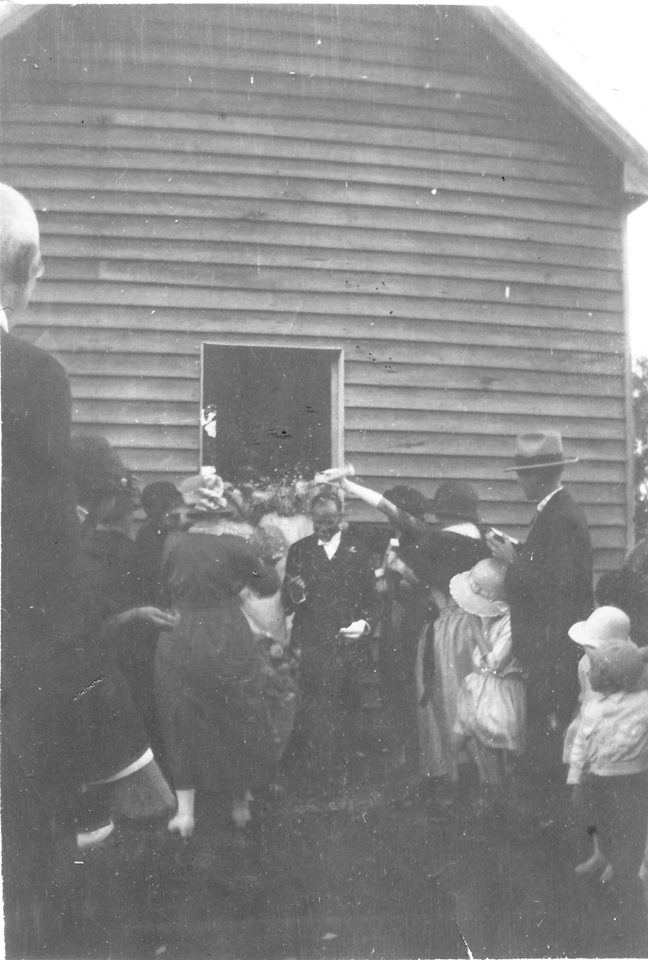
Wesleyan, Methodist and Anglican services were conducted at the Union Church on consecutive Sundays, whilst Sunday School and Salvation Army services were held in the old Church Hall. In later years the Union Church was also used for Presbyterian, Baptist and Uniting Church services.
The Women’s Missionary Society was formed in 1916, but they later changed their name to the Church Women’s Committee. These women were an integral part of the church community; not only excelling in fundraising but also instrumental in the ongoing maintenance of the Church buildings. They also made regular donations to other Churches and charities, provided assistance and support to the Sunday School and fulfilled all the domestic requirements of the Church premises. This group of hard working women were able to maintain strong support to the church for many years.
In 1918 the Church Committee found themselves in the unusual position of having to purchase the land on which the Church had been erected. The Barham estate had been sold and the new owner, Edwin Sherwin Rowe, received from the Church Committee the sum of 128 pound. Once again the families of the district had dug deep and gave generously so that the Union Church and its grounds became the property of the Tomerong community in its entirety.
By 1931 the old Church Hall was succumbing to the ravages of time and it was decided to demolish the building and erect a Sunday School Hall on the same site, just south of the Church.
In 1958 the growing number of Sunday School pupils warranted the expansion of the building and a new wing was a dded to the eastern side.
Centenary celebrations in 1977 reunited families and old friends alike. This grand milestone was celebrated in style with a re-union dinner and centenary church service held over the weekend of September 17 and 18. Complete with a new coat of paint, the Church and Sunday School buildings were in fine condition for the occasion.
Although the Centenary of the Church raised an awareness of its history, a decline in attendance at services had begun. This was reflected in the closure of the Sunday School two years later and the cessation of Salvation Army services soon after. Although the area was experiencing a surge in population, a change in lifestyles of the younger and newer members of the community meant that regular Church services were less relevant. Those who did attend worship were more likely to attend larger Churches at Huskisson and Nowra, at the more popular service times, than wait for afternoon services at Tomerong. The aging congregation continued to decline, which led to the dissolution of the Church Committee in 1987 and eventually the cessation of regular services by all denominations. This was a sad turn of events, as the Tomerong Union Church had been an integral part of the community for well over a century, thanks to the devotion and commitment of the residents, many of whom were descended from the pioneers who helped to establish it.
The launch of a local history book about Tomerong in May of 2001 helped to raise the profile of the church’s plight. Proceeds from the sale of this book has recommenced the building maintenance fund. This prompted the formation of a new and energetic community group known as The Friends of Tomerong Union Church Inc. (FOTUC). The Friends are operating as a non-religious group with the objectives of assisting the Church Trustees in the restoration, preservation and maintenance of the church buildings and grounds. It is hoped that this will encourage and promote appropriate community use of these buildings and preserve this significant local heritage site.
This, and more information regarding the local history of Tomerong, is available from: Tomerong: A Local History, as well as from ‘From Bullocks to Bypass’ by Margaret Blair.
Sources:
Blair, M. (2000). From Bullocks to Bypass. Tomerong, NSW, Australia.
Blair, M. (2007). The Union Church. Retrieved January 21, 2014, from Tomerong Local History: A Glimpse into the Past: http://home.exetel.com.au/tomerong/history2/index_files/Page684.htm
 Tomerong Union Church